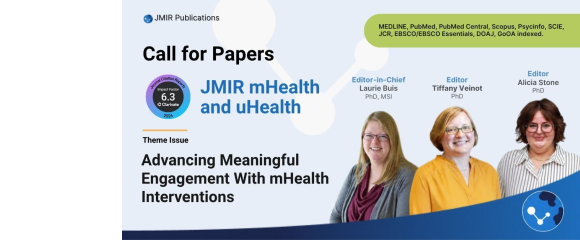
Call for Papers: Advancing Meaningful Engagement With mHealth Interventions
As the number of mHealth tools grows, the field of digital health needs to re-examine and expand its understanding of mHealth engagement. Recently, there have been shifts towards understanding "meaningful engagement," or interactions with a tool sufficient to achieve desired clinical or health outcomes. This approach moves past simple associations between demographics and clicks or merely quantifying use patterns, however; additional work is needed to explore the complex factors that influence engagement behaviors. Poor engagement, characterized by high attrition rates and inconsistent usage patterns, limits the efficacy, scalability, and long-term health impact of these digital health tools. Overcoming these limitations requires moving past rudimentary metrics, as a deeper understanding of engagement is foundational to building more sustainable, user-centered health technologies. While there have been many attempts to define, measure, and promote engagement, the rapid evolution of mHealth tools requires a reflexive and updated approach.
JMIR mHealth and uHealth is inviting submissions to a new theme issue titled “Advancing Meaningful Engagement With mHealth Interventions”. This theme issue will feature innovative research and provocative viewpoints that challenge foundational assumptions about how users interact with digital tools. Moving beyond basic usage analytics, editors will prioritize innovative research that treats engagement as a primary outcome and unpacks its role within complex, multicomponent interventions. We seek research that investigates psychosocial factors, novel measurement strategies, and real-world innovations that contribute to the field’s evolving understanding of engagement.
Topics of interest include, but are not limited to:
- Moving beyond frequency of use to establish frameworks for meaningful engagement
- Understanding complex psychosocial factors beyond simple demographics that drive user interaction
- Developing methods and strategies to increase short- and long-term engagement
- Design elements and considerations that promote meaningful engagement with mHealth tools
- Implementation considerations that increase engagement with mHealth interventions
- Evolving approaches to predict mHealth engagement (eg, machine learning, sensing technologies, novel patient engagement approaches)
We welcome original research with broad methodologies and systematic or scoping reviews, and highly encourage theoretical or conceptual viewpoints that offer novel insights into fundamental engagement issues. We seek research that questions baseline assumptions, pushes the boundaries of existing literature, and identifies future directions of engagement research. Whether situated in clinical or community settings, submissions must demonstrate methodological rigor and provide actionable mHealth implications.
How to Submit
To submit an article to JMIR mHealth and uHealth, please visit the submission page. Consult our Instructions for Authors for more information on how to submit a manuscript.
Submission Deadline: March 31, 2027
Submission Guidelines
We will not accept articles that are solely written by generative artificial intelligence (AI) or other AI tools. For more information, please refer to the JMIR Publications editorial policy and this knowledge base article. The journal is indexed in PubMed, PubMed Central, Scopus, DOAJ, Web of Science, Sherpa Romeo, and EBSCO and EBSCO Essentials.
All submissions will undergo a rigorous peer-review process, and accepted articles will be published as part of the theme issue. All articles will be shared and published rapidly through the following mechanisms:
- All peer-reviewed articles will be immediately and permanently made open access. This is the standard for all titles within the JMIR Publications portfolio.
- Articles can be made immediately available in JMIR Preprints (with a DOI) after submission if authors select the preprint option at submission to enable this service.
Submissions not reviewed or accepted for publication in JMIR mHealth and uHealth may be offered cascading peer review or transfer to other JMIR Publications journals, according to standard JMIR Publications policies. Authors are encouraged to submit study protocols or grant proposals to JMIR Research Protocols before data acquisition to preregister the study as a registered report.
Editors:
Laurie Buis, PhD
Dr Max and Buena Lichter Research Professor of Family Medicine, Associate Chair, Department of Family Medicine, Associate Professor of Family Medicine, Medical School, Associate Professor of Information, School of Information, University of Michigan
Tiffany Veinot, PhD
Joan C Durrance Collegiate Professor of Information, Professor of Information, School of Information, Professor of Learning Health Science, Medical School and Professor of Health Behavior and Health Equity, School of Public Health, University of Michigan
Alicia Stone, PhD
Scientific Editor, JMIR Publications Inc